
Our product rankings are based on analysis of thousands of customer reviews, brand reputation, pricing trends, and popularity data. They represent our honest opinion and are intended as a helpful starting point for your research. Some links on this site are affiliate links — if you buy through them, we may earn a small commission at no extra cost to you. This helps us keep the site free and up to date.
A wood effect hot tub is a portable spa whose outer wall is printed or moulded to look like timber staves. Underneath it is the same kit as any other inflatable: a PVC or drop-stitch shell, a pump that heats, filters and drives the air jets, and an insulated cover. You fill it from a garden hose, plug it into a 13A outdoor socket and it warms the water to a maximum of around 40°C.
The appeal is simple. A bright blue or white inflatable can look out of place on a lawn, while a brown, oak, walnut or weathered-grey grain sits more naturally next to fences, sheds, decking and planters. You get much of the look of a barrel tub without the price, weight or upkeep of real timber.
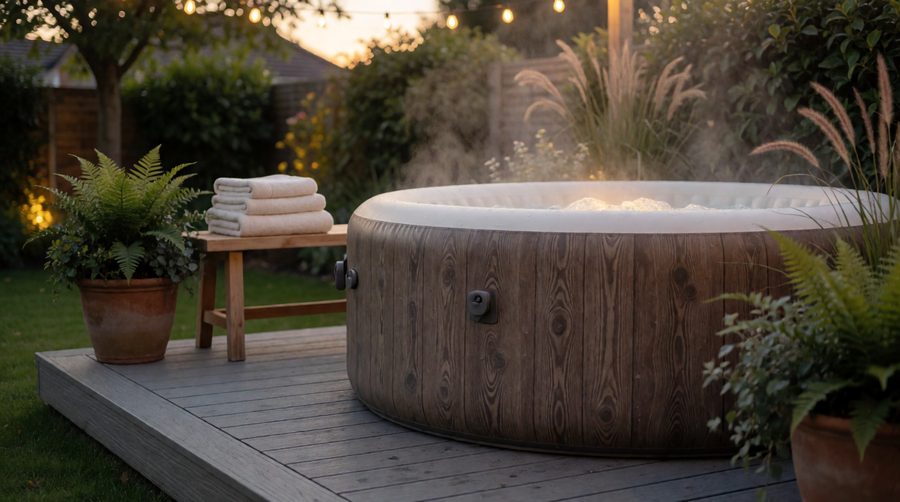
Most of what you'll find when you search for this term is real wooden tubs: Scandinavian-style barrel and panel designs in thermowood, spruce, larch or cedar, usually heated by a wood-burning stove. They are lovely things, but they are a very different purchase. Here's how the two compare.
| Wood effect (inflatable) | Real wooden tub | |
|---|---|---|
| Outer wall | Printed or textured PVC, drop-stitch or foam panels | Thermowood, spruce, larch or cedar cladding |
| Heating | Electric, around 2,000-2,240W from a 13A plug | Mostly wood-fired stoves (internal or external), some electric |
| Heat-up time | Slow: about 1-2°C an hour, so a fresh fill takes most of a day | Fast once lit: Skargards quotes 2-3.5 hours from 6 to 39°C |
| Setup | DIY, often under an hour to inflate | Delivered, sited on a level base, sometimes professionally installed |
| Moving or storing | Drain, deflate and pack away | Stays put |
| Typical price | A few hundred pounds | Thousands - one cedar range starts at £6,495 |
| Upkeep | Wipe the print, cover it, store it in winter if you want | Oil or treat the timber, keep the staves swollen and watertight |
If you love the ritual of lighting a fire and want a permanent garden feature, a real wooden tub is worth the investment. If you want the timber look, an easy plug-in setup and something you can pack away or take with you when you move, a timber-look inflatable makes far more sense - and for many budgets it's the only realistic option. Our cheap hot tubs page shows how far your money goes.
These are the timber-look tubs in our range, with figures taken from the product listings. Stock comes and goes, so some may be unavailable when you visit; the cards above show what you can buy today.
| Model | Size | Seats | Water | Jets | Heater / motor | Finish |
|---|---|---|---|---|---|---|
| Lay-Z-Spa Helsinki Smart AirJet Plus | 180 x 66cm | Up to 7 | - | 180 | 2,200W heater | Brown timber print |
| Lay-Z-Spa Helsinki AirJet (60025) | 180 x 66cm | 5-7 | 1,020 litres | 180 | 2,200W heater | Brown timber print |
| MSpa Tribeca | 160 x 160 x 66cm (diamond) | 4-6 | - | 120 | Heat Tech, 13A plug | Dark walnut-like |
| Intex PureSpa Greywood Deluxe | 216 x 71cm | 6 | 1,098 litres | 170 | 2,200W heater | Grey weathered grain |
| Coco Spa Helsinki 180 | 180 x 70cm | 6 | 1,100 litres | 140 | 2,240W | Timber print |
| Coco Spa Nordik 180 | 180 x 70cm | Up to 6 | 1,100 litres | 140 | 2,240W | Nordic timber print |
| Coco Spa Tahiti / Exotik | 180 x 70cm | 6 | 1,100 litres | 140 | 2,040W | Wood imitation |
| Coco Spa Helsinki / Nordik / Bali 150 | 150 x 70cm | 2-4 | 800 litres | 140 | 2,240W | Timber print |
A few patterns stand out. The Coco Spa models all use 5cm drop-stitch walls, which keep a firmer, straighter side than a standard air chamber. The Lay-Z-Spa Helsinki tubs pack the most jets (180) into a 180cm round, while the Intex Greywood is the widest at 216cm. If you want a classic barrel shape, see our full range of round hot tubs; the MSpa Tribeca's diamond footprint is the one to look at if your patio suits a squarer shape.

Seat counts are generous. A 150cm tub holding 800 litres is comfortable for two adults and fine for four friends at a squeeze; a 180cm round suits four to six; a 216cm tub gives six adults room to stretch. Measure your space and allow at least 50cm around the tub for getting in and out. For couples, our 2 person hot tubs are a better fit and heat faster.
Standard inflatables use a single air chamber, which can feel soft when you lean on the side. Drop-stitch walls (Coco Spa, Lay-Z-Spa Helsinki) are threaded internally so they inflate firm and flat - closer to the solid feel of a timber tub, and the straight sides show off a printed grain far better than a bulging wall does.
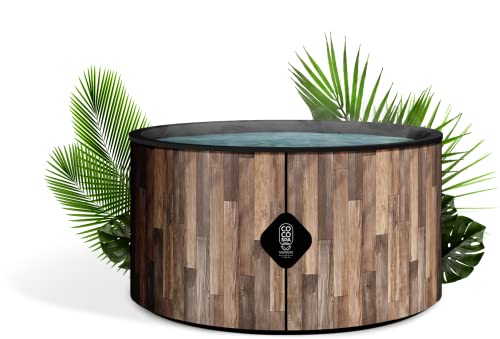
Almost every model here tops out at 40°C (some Coco Spa listings say 42°C). Expect 1-2°C an hour: the Lay-Z-Spa Helsinki quotes 1-2°C, the Coco Spa 150cm models 1.5-2°C. Starting from cold tap water at around 10-15°C, that means 12-24 hours before your first soak, so fill the day before. If you want to use it through the winter, look for freeze protection: Lay-Z-Spa's Freeze Shield keeps the water from dropping too low, and the MSpa Tribeca has an anti-icing system.
All of these use air bubble jets rather than the water jets of a fixed acrylic spa. More jets (120 to 180 here) means a fuller, fizzier feel, but no inflatable delivers a targeted deep-tissue massage. If that matters, you're into fixed spa territory.

The newer models let you set the temperature from your phone, so the tub is warm when you get home. The Helsinki Smart AirJet Plus uses the Bestway Smart Hub app, and the Tribeca has WiFi control plus a UVC sanitiser to help keep the water clean. Check what's in the box too: insulated covers, floor mats or ground sheets, filters and chemical dispensers are often included, and they save a separate shopping list.
Prints vary from a warm brown oak to a near-black walnut and the grey, weathered-deck look of the Intex Greywood. Look at product photos in daylight and think about what's around the tub: a grey grain sits well with composite decking and modern fences, while a warm brown suits natural timber and cottage gardens.

The print does a lot of the work, but where you put the tub does the rest.
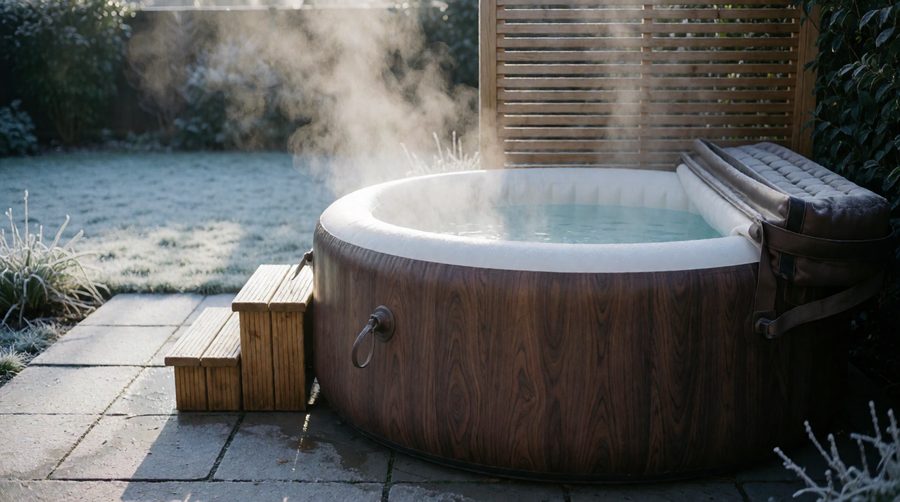
Most of the electricity goes on heating. A 2,200W heater uses 2.2kWh for every hour it runs, and bringing 800-1,100 litres of fresh water up to temperature takes roughly 20-35kWh, depending on the weather and the starting temperature. After that, the cover and the insulation do the work, and the heater only tops up. Multiply the kWh by your own tariff - the Ofgem energy price cap page explains the current unit rates. Keeping the lid on, sheltering the tub from wind and using an insulated ground mat all cut running costs. If budget is the main concern, see our hot tubs under £300 too.
Plug-in hot tubs are designed for a 13A socket, but the socket should be outdoor-rated and protected by a 30mA RCD, and kept well back from the tub. The IET guidance on hot tub electrics explains why fixed wiring with an isolator at least 2 metres from the water is best practice, and why a registered electrician should check your setup. Don't run a hot tub from a domestic extension lead.
Warm, bubbling water is ideal for bacteria, including legionella, if it isn't kept clean and disinfected. Test and dose the water regularly, keep filters clean and change the water as the manual advises. The NHS guide to Legionnaires’ disease covers the symptoms, and if you're thinking of offering a hot tub at a holiday let, read the HSE advice on spa pools first - inflatable tubs aren't acceptable for most commercial use.
No. The outer wall is PVC, drop-stitch fabric or foam panels printed or textured to look like timber. That's what keeps the price, weight and upkeep down.
Any printed finish will fade slowly with years of direct sun. Keeping the cover on, shading the tub in summer and storing it out of the weather when you're not using it will keep it looking fresh much longer.
About 1-2°C an hour on the models here, so 12-24 hours from a cold fill. Once it's hot, keep the lid on and it only needs topping up.
Yes, if it has freeze protection (such as Lay-Z-Spa's Freeze Shield or MSpa's anti-icing system), you keep it heated and covered, and it's on a solid base. Running costs rise in cold weather, so many owners pack theirs away from November to March.
Our timber-look tubs range from 2-4 person (150cm, 800 litres) to 7 person (180cm Lay-Z-Spa Helsinki). Four adults is comfortable in a 180cm round; six is a squeeze. For bigger groups, our 6 person inflatable hot tubs are worth a look.
For most gardens, a 180cm drop-stitch tub such as the Lay-Z-Spa Helsinki or Coco Spa Nordik strikes the best balance of space, firmness and heating. For couples or small patios, the 150cm Coco Spa models are quicker and cheaper to heat. For our wider round-up across every style, see the best inflatable hot tub picks.
