
Our product rankings are based on analysis of thousands of customer reviews, brand reputation, pricing trends, and popularity data. They represent our honest opinion and are intended as a helpful starting point for your research. Some links on this site are affiliate links — if you buy through them, we may earn a small commission at no extra cost to you. This helps us keep the site free and up to date.
Round is the traditional shape for inflatable hot tubs, and there are good reasons for it. An air-filled wall holds its shape best as a circle, because the pressure is spread evenly with no corners to bulge or crease. That makes the hot tub firmer to lean against and kinder to the seams.
The shape also changes how a soak feels. Everyone faces the centre, so conversation is easier than in a square hot tub where two people end up shoulder to shoulder along a side. Round lids have no corners to seal either, so they sit flat and keep heat in well, which matters because the open water surface is where a hot tub loses most of its warmth.
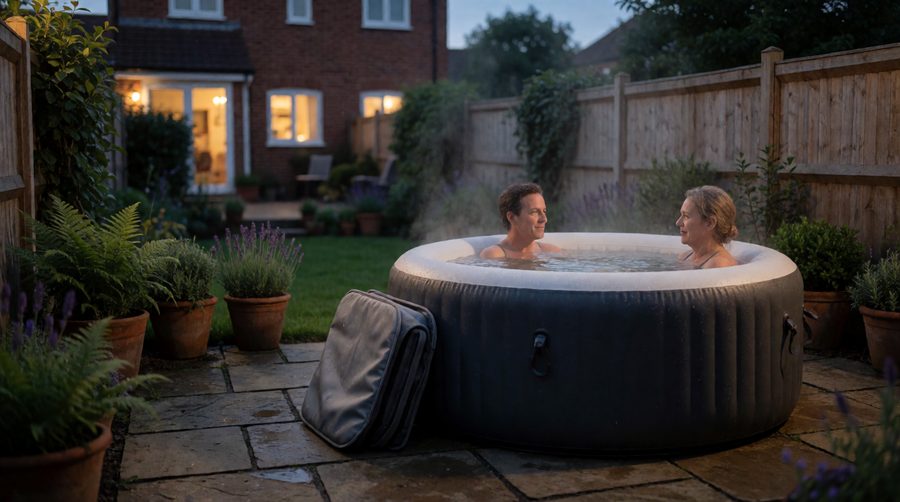
A circle takes up less floor area than a square of the same width. A 180cm round hot tub covers about 2.54m², while a 180cm square one covers 3.24m², so the circular version uses roughly a fifth less of your patio. That leaves room for steps, a side table or a path around it.
| Round | Square | |
|---|---|---|
| Seating | Everyone faces the middle | Two to a side, corner seats |
| Footprint at 180cm wide | About 2.54m² | About 3.24m² |
| Wall strength (inflatable) | Even pressure all round | Corners take extra strain |
| Best spot | Open patio, middle of a deck, lawn edge | Tucked into a corner or against a wall |
| Lid fit | No corners to seal | Corners can lift in wind |
If your space is a corner between two fences, a square hot tub may use it better. For an open patio, the circle usually wins.
Box sizes are quoted as the outside diameter, and an inflatable wall is thick. The Lay-Z-Spa St Lucia is 170cm across but only 124cm inside, so always check the interior size or the seat count. As a rough guide:
Manufacturer seat counts are the maximum, not the comfortable number. Knock one off the figure if you want room to stretch out.

These are the circular hot tubs from our range with figures taken from each listing. Litres are left blank where the maker doesn't give a reliable figure.
| Model | Outside diameter | Seats | Water | Jets | Wall |
|---|---|---|---|---|---|
| Wave Tahoe | 156cm | 4-6 | - | 90 AquaJets | PU foam core |
| Lay-Z-Spa St Lucia | 170cm | 2-3 | 605L | 110 | 3-layer PVC, I-beam |
| Lay-Z-Spa Aruba Signature | 170cm | 3 | - | 110 | 3-layer PVC |
| Lay-Z-Spa Carrara | 170cm | 4-6 | - | 140 | ThermaCore foam |
| Lay-Z-Spa Boracay | 180cm | 4 | 669L | 120 | 3-layer PVC |
| Lay-Z-Spa Helsinki AirJet Plus | 180cm | up to 7 | - | 180 | Drop stitch |
| Coleman Palm Springs | 196cm | 4-6 | - | 140 | 3-layer PVC |
| Lay-Z-Spa Palm Springs AirJet 6 | 196cm | 4-6 | - | 140 | PVC |
| Lay-Z-Spa New York | 196cm | 6 | - | 140 | TriTech 3-layer |
| Aoxun 208cm | 208cm | 4 | 1,000L | 130 | 3-layer PVC |
| Intex PureSpa Bubble 8 | 236cm | 8 | 1,340L | 170 | Fiber-Tech beams |
Jet counts on air-bubble spas are the number of holes in the floor ring rather than separate massage nozzles, so 110 and 140 feel similar. The bigger differences are wall type, insulation and seat count.
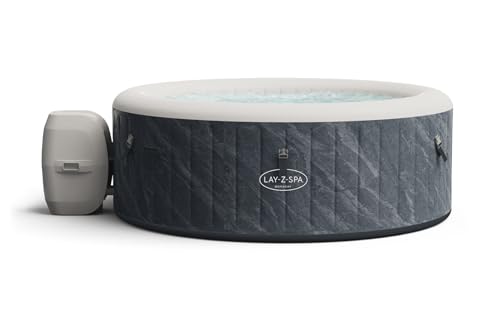
Most budget inflatable hot tubs use a laminated PVC wall held in shape by internal beams (I-beam, Fiber-Tech or MaxHold). They are light, pack small and are the cheapest to buy, which is why so many of our hot tubs under £300 take this form. The walls flex a little when you lean back.
Drop stitch walls have thousands of threads linking the inner and outer skins, so they inflate much firmer and sit more upright. The Lay-Z-Spa Helsinki uses it, and it is the step up most buyers notice straight away.
Foam-wall tubs such as the Wave Tahoe and Lay-Z-Spa Carrara swap air for an insulated foam core. Wave claims 60% better heat retention than standard PVC and Lay-Z-Spa says 60% more efficient, so they cost less to keep warm through a British winter, though they are heavier and take more space to store.
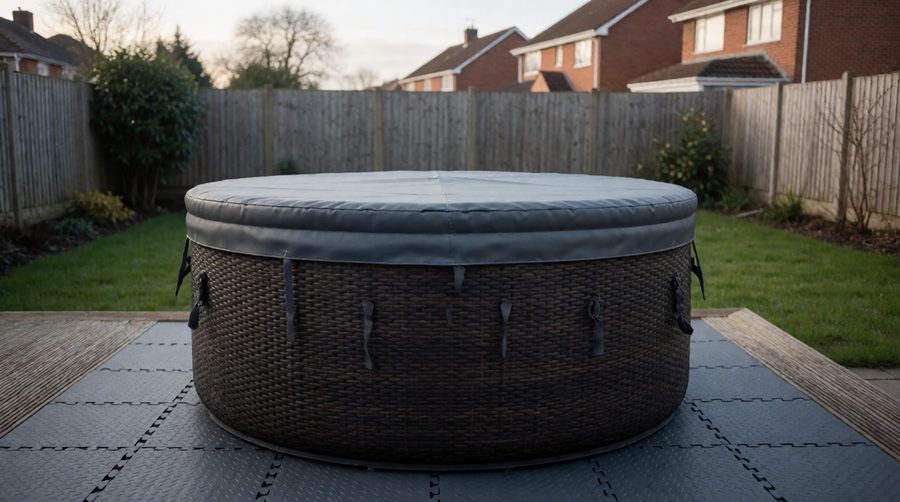
Nearly every inflatable hot tub is plug and play: it runs from a standard 13A socket through the RCD built into its plug or pump. The heaters are around 1.5-2.2kW, which is why warming the water is slow. The St Lucia quotes 1.5-2°C an hour, the 1,340-litre Intex 0.8-1.5°C, and Lay-Z-Spa allows 12-24 hours for the Boracay's first heat from cold.

Water weighs 1kg a litre, so a 605-litre tub weighs well over half a tonne before anyone gets in, and the Intex 8 person holds 1,340 litres. Choose a flat, level, solid base such as paving slabs, a concrete pad or a deck rated for the load. Lawn is a poor choice: it sinks unevenly and the grass dies underneath.
Want it to blend into the garden? Our wood effect hot tubs include several circular models with timber-look walls.
Many Lay-Z-Spa and Coleman spas have Freeze Shield, which turns the heater on automatically when the water drops to 6°C and off again at 10°C. That protects the pipes, but it isn't a reason to leave a hot tub idle and unheated in a hard frost. If you won't use it for weeks, drain, dry and store it. Foam-wall and drop stitch tubs, and a good lid, make year-round use far more practical.
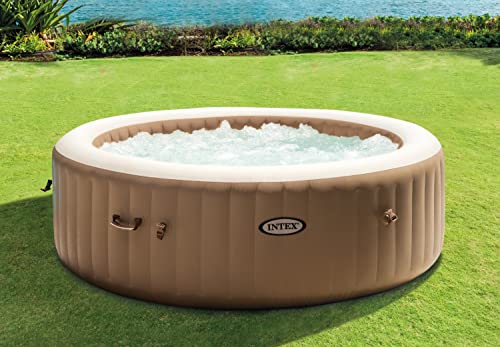
RoSPA advises no under-fives in a hot tub, sessions of about 15 minutes, a solid lockable cover and constant supervision of children near open water. It also suggests checking that a hot tub meets BS EN 17125:2018 and BS EN 60335-2-60.
Warm, still water can grow bacteria, including legionella. Keep the sanitiser level up, change the filter cartridges as the manual says and replace the water regularly. The HSE guidance on spa pools explains the risk, and applies in full if you let the tub out as part of a holiday let or business.
Inflatable circular spas usually measure 156-236cm across the outside and about 65-73cm high. The inside is much smaller because of the wall: a 170cm St Lucia is 124cm inside.
Roughly two to three at 170cm, four at 180cm, four to six at around 196cm and up to eight at 236cm. The quoted figure is a maximum, so one fewer is more comfortable.
For most patios, yes: they take up less floor area for the same width, everyone faces each other and inflatable walls hold their shape better. A square model suits a corner better.
Expect 1-2°C an hour, so a first fill from cold can take 12-24 hours. Keeping the lid on and the water warm between sessions is quicker and cheaper than reheating from cold.
Yes, inflatable models run on a 13A plug with a built-in RCD. Use an outdoor weatherproof socket and don't run it through an extension lead.
Count 1kg for every litre of water plus the people in it. A 669-litre 180cm tub weighs about 670kg in water alone and close to a tonne with four adults in, so a deck or balcony must be rated for it.
You can if you keep it heated, lidded and use Freeze Shield where fitted. If it will sit unused, draining and storing it dry is safer for the liner and pump.
A level, solid surface, then the ground sheet supplied and insulated floor tiles. They protect the base from stones and cut heat loss into the ground.


