
Our product rankings are based on analysis of thousands of customer reviews, brand reputation, pricing trends, and popularity data. They represent our honest opinion and are intended as a helpful starting point for your research. Some links on this site are affiliate links — if you buy through them, we may earn a small commission at no extra cost to you. This helps us keep the site free and up to date.
It is a spa sized for two adults to sit comfortably with their legs stretched out. In the inflatable world that usually means one of two shapes: an oval tub of about 186-190cm by 120-125cm, or a small round one of 150-170cm across. Both hold far less water than a family tub, typically 550-800 litres against 1,000 litres or more for a 6 person inflatable hot tub.
Less water means a quicker heat-up, a smaller footprint and lower running costs, which is why these tubs suit couples, flats with a courtyard, small terraced-house gardens and holiday cottages sold on romantic breaks. The trade-off is obvious: there's no space for friends, and the children will have to wait their turn.
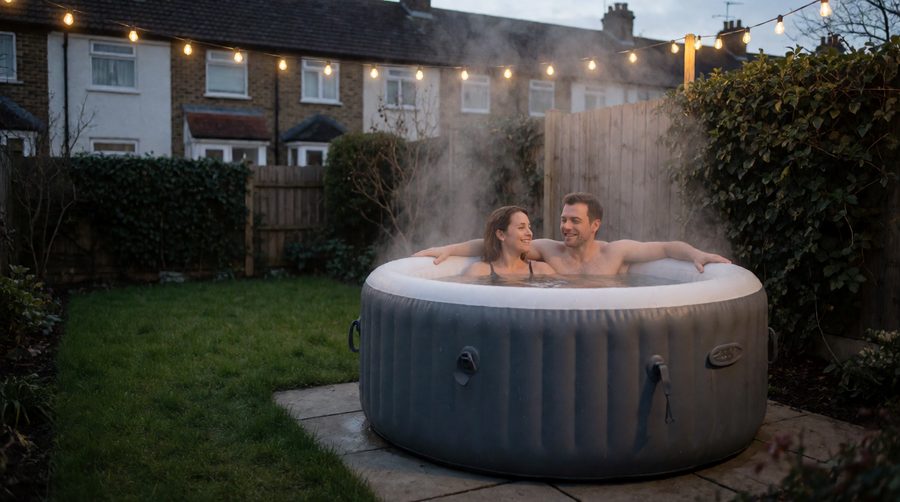
Oval models such as the Arebos 190 x 120cm and the MSpa Nest (186 x 125cm) are built for exactly two people sitting face to face. They fit along a fence or wall where a round tub would stick out, and most hold around 550 litres. The Arebos interior is 150 x 80cm, so it's cosy rather than roomy.
A 170cm round tub like the Lay-Z-Spa St Lucia gives two people space to spread out and can take a third. Round shapes are the most common inflatable design, so there's more choice of colours, covers and spare parts. See the full range of round hot tubs.
Square inflatables like the 180cm Cancun sit neatly into a corner and give each bather a side to lean on. They're usually rated 2-4 people, so for two it feels generous.

These are real figures from the listings in our range. Interior space matters more than the outside size: inflatable walls are thick, so a 170cm tub may only be 124cm across inside.
| Model | Shape | Outside size | Water | Jets | Heating | Seats |
|---|---|---|---|---|---|---|
| Arebos oval | Oval | 190 x 120 x 65cm | 550 litres | 90 bubble | 1-2°C an hour | 2 |
| MSpa Nest | Oval | 186 x 125 x 68cm | 550 litres | 104 bubble | 1,500W, 2-2.5°C an hour | 2 |
| Zikebtuy oval | Oval | 190 x 120 x 64cm | 799 litres | 120 bubble | 1,800W heater | 2 |
| Lay-Z-Spa St Lucia | Round | 170 x 66cm | 605 litres | 110 AirJet | 1.5-2°C an hour | 2-3 |
| Lay-Z-Spa Aruba | Round | 170 x 66cm | 800 litres | 110 AirJet | 1.5kW heater | 3 |
| Lay-Z-Spa Cancun | Square | 180 x 180 x 66cm | 669 litres | 120 AirJet | About 12 hours from cold | 2-4 |
| Canadian Spa Co. Yukon AI | Rectangular (acrylic) | 213 x 100 x 74cm | 350 litres | 16 water jets | About 5 hours, 10-38°C | 2 |
If the tub may get a third bather now and then, the Aruba's 800 litres or the Cancun's 2-4 rating give you that headroom for very little extra space.
Allow at least 30-50cm around the tub for getting in and out, the cover and the pump unit, which sits outside the wall on most inflatables. An oval tub needs a level patch of about 2.3 x 1.7m; a 170cm round needs roughly 2.2m square.
A litre of water weighs a kilo, so a 550-litre tub holds over half a tonne before anyone gets in. Bestway lists its 180cm square model at 696kg when filled. Paving slabs or a level concrete base are ideal. Older timber decking should be checked before you fill a tub on it, and the base must be flat or the walls will strain.
Inflatables use air bubble jets: a blower pushes air through 90-140 holes around the floor or walls. It feels like a fizzy, all-over massage rather than the targeted water jets of an acrylic spa. Most heaters pause while the bubbles run, so long massage sessions slow the heat-up.
Grey and charcoal are the norm, but you can also get timber-style walls; see our wood effect inflatable hot tubs if it will be on show from the house.
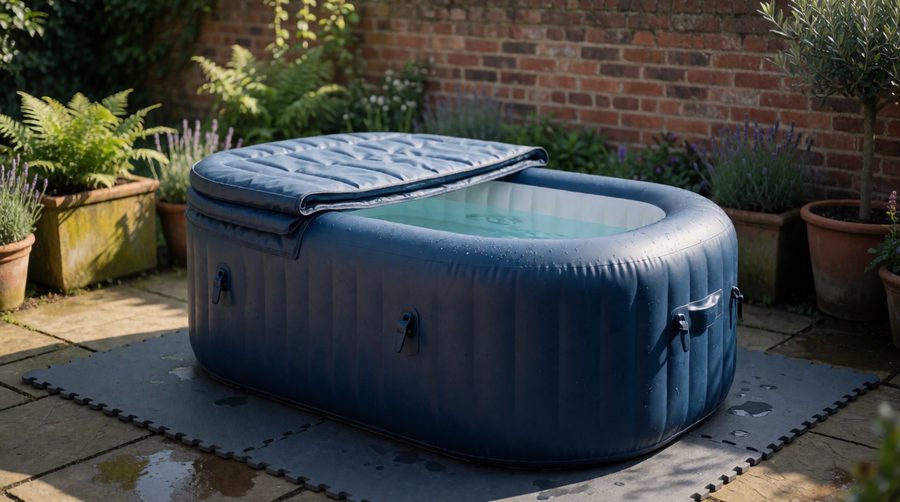
Small tubs heat faster simply because there's less water. Heating 550 litres from 10°C to 38°C takes about 18kWh of energy in theory; 800 litres needs about 26kWh, and real figures are higher because heat escapes through the walls and cover. With heaters that add 1.5-2.5°C an hour, the first fill takes most of a day, so fill it the morning before you want it.
After that, cost depends on how often it's used, the weather and the cover. To estimate yours, multiply the heater's rating (1.35-2.1kW on the models in our range) by the hours it runs and by your unit rate; Ofgem's price cap page shows the current cap rates. Appliances Direct has a worked example of how much it costs to run a hot tub. Keep the insulated lid on, put a thermal mat underneath and use the timer, and a two-seater stays one of the cheapest spas to run.

An inflatable is the budget route; most in our range sit well below the price of a rigid spa, and our best inflatable hot tubs under £400 and cheap hot tubs under £500 are a good place to compare. You can deflate it for winter or take it when you move, but the walls insulate less well and the bubble jets are gentle.
A rigid acrylic 2 person hot tub such as the Yukon AI has moulded seats, real hydrotherapy jets and better insulation, yet still plugs into a 13 amp socket. It costs more and stays put once filled, so it suits people who want to use it all year rather than for a summer season.


Inflatable oval two-seaters are about 186-190cm long and 120-125cm wide; round ones are 150-170cm across. Most hold 550-800 litres and stand 64-70cm tall.
In an oval two-seater, not comfortably. In a 170cm round tub like the St Lucia (2-3) or Aruba (3), yes. If you often have guests, a 6 person inflatable hot tub makes more sense.
Most inflatables rise 1-2.5°C an hour, so expect 12-24 hours from a cold fill depending on the tap water temperature, the heater and the weather. The acrylic Yukon AI quotes about 5 hours from 10°C to 38°C.
Yes. There's less water to heat and a smaller surface losing heat, so a two-seater uses less electricity than a 4-6 person tub on the same settings and with the same cover.
Only if the structure can take it. A small tub weighs 550-800kg filled, plus two adults. Check decking with a builder and avoid balconies unless a structural engineer confirms they're safe.
Some, such as the Zikebtuy oval, are listed for indoor and outdoor use. Indoors you need a floor that takes the weight, a drain nearby and good ventilation to deal with the humidity.
